
Token Budget Discipline: A Developer’s Playbook
A practical playbook for treating model quotas like engineering budgets: route requests, reserve premium capacity, and avoid cooldown stalls.

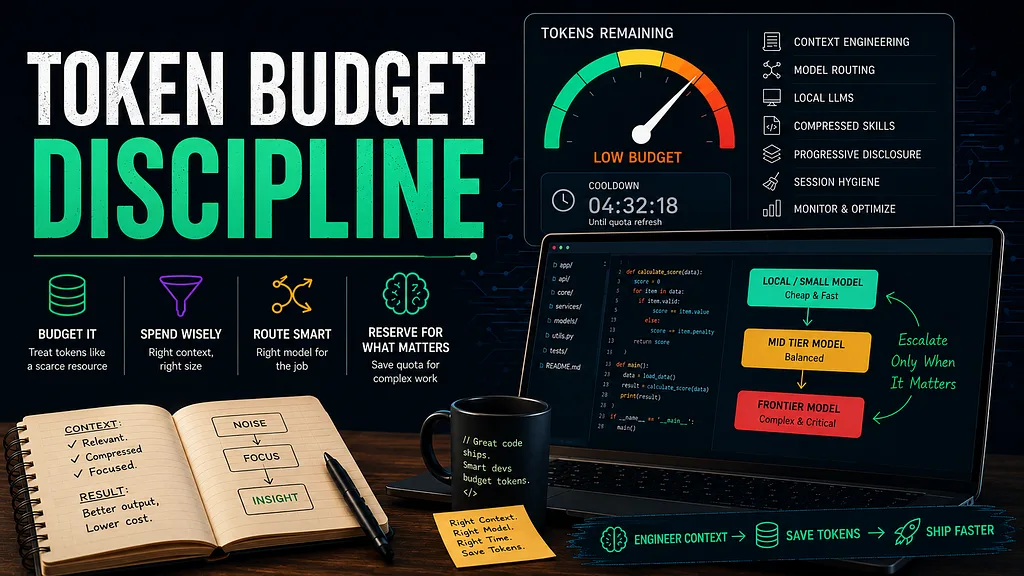
You opened Claude Desktop, asked Opus 4.7 to polish three slides, and 15 minutes later your entire afternoon quota is gone. Sound familiar?
Every major LLM surface you touch — Claude Desktop, Claude Code, ChatGPT, GitHub Copilot, Cursor — now meters your work in tokens, messages, or opaque “usage limits.” The rules differ per product, but the pain is the same: you burn through budget on a small task, then sit in a 4–5 hour cooldown while a large migration, PR review, or incident response still needs GenAI.
This is not an enterprise architecture problem. It is a developer workflow problem. The fix is not “buy more seats.” It is learning to treat tokens like CPU, memory, or CI minutes: a scarce resource you budget, monitor, and route.
The new constraint: quota is the API
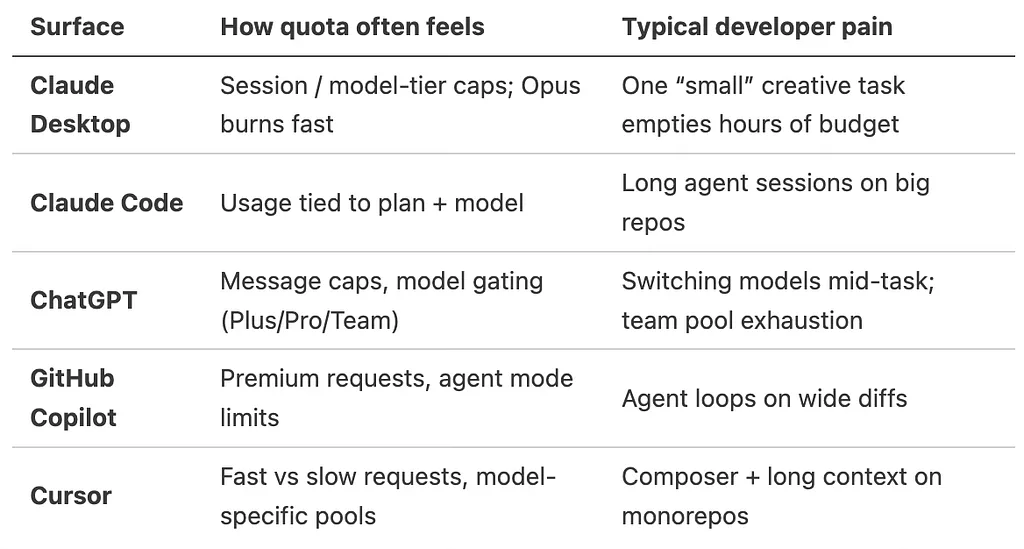
Providers rarely expose a single “tokens remaining” dial you can trust across tools. What you can control is what you send, which model reads it, and when you escalate to a frontier model.
Think of this as token budget discipline (not “token anxiety”): deliberate choices so GenAI stays available when it matters.
A real failure mode
You are not imagining it. Frontier models on desktop UIs are optimized for quality and long context — not for frugality. A request like “turn these bullets into three executive slides” can pull in:
- Your pasted notes (large)
- Implicit style / brand instructions (re-sent every turn)
- Multiple revision rounds (each re-sends growing history)
- High reasoning depth on Opus-class models
Result: quota gone for ~5 hours; migration work continues without AI for the rest of the afternoon.
Scale that to a team: ten developers on a Strangler Fig migration all run agent mode against the same monorepo. By 11am, half the team is on manual refactor while deadlines do not move. That is quota bankruptcy — and it is operational, not theoretical.
Principle 1: Context engineering is how you spend less
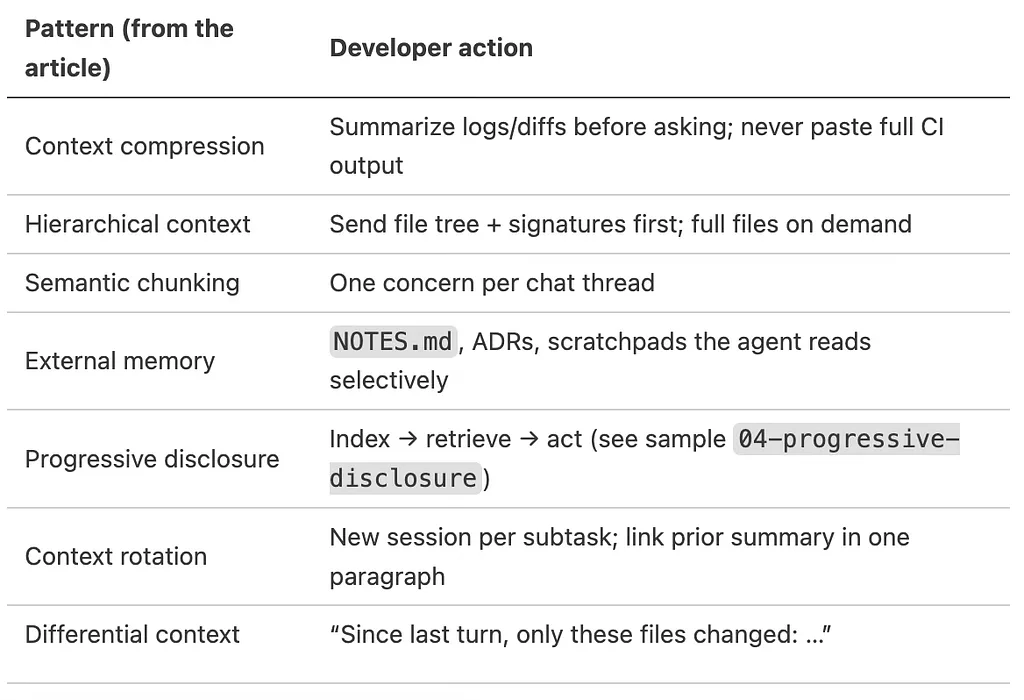
Prompt tricks alone will not save you. Context engineering is the discipline of putting only the right information in the window for this step — compression, selection, isolation, and external memory.
I wrote a deeper pattern catalog here:
- Medium: Patterns for Context Engineering in Agentic Applications (see your profile feed for the latest permalink)
Read that article when you want the “why” and the eight patterns. This post focuses on day-to-day developer tactics that implement those ideas without a platform team.
Quick summary:
Principle 2: Model routing — right brain, right price
Not every task deserves Opus, GPT-4.1, or Cursor’s heaviest model.
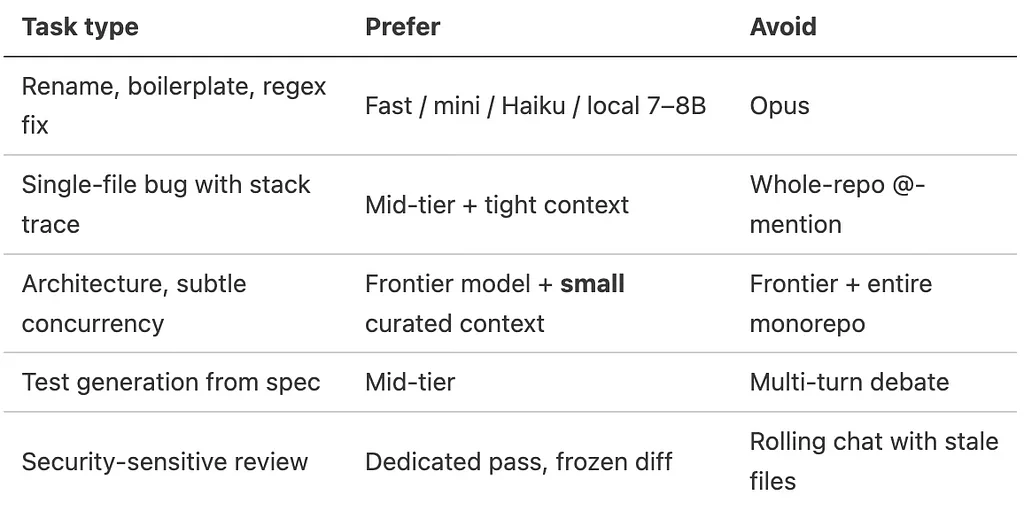
Rule: Escalate the model only after you have escalated the quality of the context.
Sample: samples/02-model-router — a tiny Python router that picks local / mid / frontier from task metadata.
Principle 3: Local LLMs for “token-free” grunt work
Your laptop (or a team GPU VM) can absorb work that does not need frontier reasoning:
- Commit message drafts from git diff –stat
- JSON/YAML formatting, enum extraction, comment cleanup
- First-pass unit test stubs from function signatures
- Grep-and-explain on a single file
Ollama (you likely already have ~/.ollama) is enough for many teams:
ollama pull ibm/granite4:small-h
ollama run ibm/granite4:small-h

ollama pull qwen2.5-coder:7b
ollama run qwen2.5-coder:7b
For shared team use, run a medium model on a small cloud GPU (L4, A10) behind an OpenAI-compatible proxy so everyone hits one endpoint — not five separate laptop quotas.
Sample: samples/05-local-ollama-router — route “small” tasks to Ollama, escalate only on confidence: low or explicit flag.
Honest limits: local models hallucinate on cross-file refactors. Use them for narrow, verifiable tasks; keep frontier budget for integration and design.
Principle 4: Skills and compressed modes (e.g. Caveman, Cavecrew)
Agent products re-send system prompts, tool definitions, and memory every turn. Custom skills (Cursor, Claude Code, Codex) let you pack recurring instructions once, in a dense form.
Two patterns I use:
- Caveman / compressed communication skills — instruct the model to drop filler while keeping technical precision (~50–75% fewer output tokens on explanations). See skills/caveman-lite/SKILL.md.
- Cavecrew-style delegation — spawn subagents (investigator / builder / reviewer) that return file:line compressed results so the main session context does not fill with prose.
Developer habit: maintain a SKILL.md per repo for “how we work here” (build, test, lint, forbidden paths) instead of pasting it into every chat.
Sample: samples/06-compressed-delegation — investigator-style response formatter.
Principle 5: Progressive disclosure in the IDE
The worst token spend is @-mentioning the repo or enabling “full codebase” for a one-line fix.
Better workflow:
- Ask for a map (tree, symbols, routes) — cheap.
- Agent reads 1–3 files — medium.
- Frontier model only for the patch plan or tricky logic — expensive.
Sample: samples/04-progressive-disclosure — index builder + selective file load.
Principle 6: Session hygiene developers actually follow
- One job per chat — “fix OAuth refresh” not “fix OAuth and refactor billing and update README.”
- Checkpoint summaries — every ~10 turns, ask: “Summarize decisions in ≤15 bullets; I’ll start a new session.” Paste only that summary forward.
- Freeze the diff — for reviews, attach git diff main…HEAD once, not live-updating files.
- Close the loop in the terminal — run tests/lint locally; paste failures only, not full green logs.
- .cursorignore / .claudeignore — exclude node_modules, build artifacts, lockfiles, generated protos.
- MCP sparingly — each tool schema costs context; enable tools you will use this session.
Principle 7: Monitor what you can (even when vendors hide the meter)
You will not always get real-time token dashboards. Still:
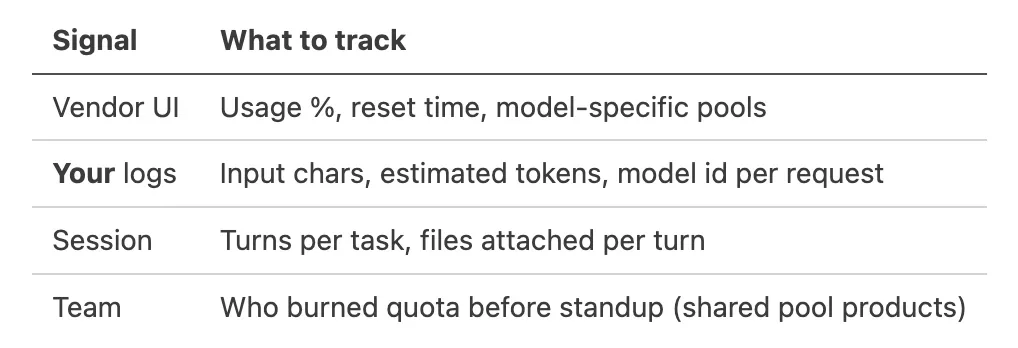
Sample: samples/03-token-monitor — wrap API calls with tiktoken estimates and CSV logging.
Budget guardrails (personal or team):
- Daily soft cap (e.g. 200k tokens frontier-equivalent)
- Alert at 70% before the big afternoon migration block
- Reserve rule: no Opus before 3pm unless incident severity = high
Principle 8: Team patterns without a platform team
You do not need a central “AI platform” to avoid collective bankruptcy:
- Shared mid-tier endpoint — one qwen2.5-coder:32b or similar on a team GPU; OpenAI-compatible API.
- Repo context pack — committed AGENTS.md + skills; stops everyone re-explaining the monorepo.
- Migration playbook — phases: inventory (local/mid) → plan (frontier, small context) → execute (mid + tight files) → review (frontier, diff only).
- Quota rota — on heavy days, name one “frontier holder” for unblock; others stay on mid/local.
- Post-incident quota retro — “What burned 40% of the pool?” beats guessing.
Principle 9: Do more with less — tactical checklist
Before you hit Enter on the next prompt:
- [ ] Can a local 7B do this with a 50-line snippet?
- [ ] Did I remove stack traces, lockfiles, and binaries from context?
- [ ] Is this a new session instead of a 40-turn thread?
- [ ] Am I on the smallest model that can fail safely?
- [ ] Did I attach only changed files?
- [ ] Will I verify in CI/tests instead of asking the model to “run mentally”?
- [ ] For agents: did I set scope (“touch only pkg/auth/”)?
- [ ] Can a skill replace three paragraphs of instructions?
When you are quota-blocked: a 5-hour survival kit
- Local model — stubs, docs, commit messages, exploratory questions.
- Offline tools — rg, ast-grep, IDE refactor, Copilot inline if still available on a different pool.
- Write for your future self — update AGENTS.md with what you learned; tomorrow’s session starts cheaper.
- Batch frontier work — queue 3–5 questions; one Opus session with prepared context beats five reactive chats.
- Human pairing — quota bankruptcy is a signal to pair, not to pretend you do not need help.
Sample code (companion repo)
Runnable examples for this article live in:
github.com/shahravir/llm-token-budget
01-context-budgetTrim and prioritize context under a token ceiling
02-model-routerRoute tasks to local / mid / frontier
03-token-monitorEstimate and log token usage per call
04-progressive-disclosureBuild repo index; load files on demand
05-local-ollama-routerOllama-first with escalation hook
06-compressed-delegationCompressed subagent-style findings
git clone https://github.com/shahravir/llm-token-budget.git
cd llm-token-budget
python -m venv .venv && source .venv/bin/activate
pip install -r requirements.txt
Closing thought
GenAI availability is now a non-functional requirement of your development environment — like bandwidth or build queue time. Developers who treat tokens as infinite will keep losing afternoons to cooldown screens. Developers who practice token budget discipline — context engineering, model routing, local fallbacks, skills, and monitoring — will still hit limits, but on their own schedule, for work that actually needs frontier models.
Go deeper on context: Patterns for Context Engineering in Agentic Applications
Go deeper on code: shahravir/llm-token-budget